Direct, don't delegate
Reflections after building a portfolio in 2026. AI, iteration, and why judgment matters more than ever.
The default is generic.
Today any developer is 5 prompts away from having a nice personal website. Hero with gradient, cards with icons, smooth animations, fully responsive. It works. It's correct. And it smells like AI from the first scroll.
I wanted something more. Not a LinkedIn profile. Not a PDF resume. Something mine —built with AI, yes, but mine.
When I started, as usual, I asked V0. It gave me exactly that: something correct, soulless. A template with my data. I could have published it as is and nothing would have happened. It was fine. Pretty good, actually. But it didn't represent me.
//Two ways of building
At work, in projects with clear rules, AI is devastating. Predictable code, bread and butter stuff. You know the destination, you have specs, constraints. The AI plots the route and you follow it. It works.
This portfolio wasn't that. I didn't know where it was going until I got into it. I had to explore, to discover as I went. I didn't want one-shots, they weren't helping. It's a different kind of building. And it requires a different way of working.
//Shorter feedback loop than ever
With AI you can validate an idea in minutes. Keep what works, discard what doesn't, ask for variations, combine parts from different responses. That used to have a cost. Now it's almost free.
This portfolio has about 190 commits in just over 20 hours of effective work. Small steps, one after another. I didn't write a single line of code manually. But I also didn't settle for the first thing the AI gave me. Or the second. Or often the tenth.
The AI generates. I direct. Reject, ask for something else, give context, iterate. But for that cycle to work, the AI has to understand what I'm looking for.
//Building context
For the AI to give me what I want, I had to understand it myself first. Define what I'm looking for. How I think. What I reject. What represents me.
And I'm not just talking about code. In a website, especially in a portfolio, the container matters as much as the content. The architecture, the design, the animations. But also the copy, the tone, the way you tell things. Everything has to be coherent. It has to feel personal.
That turned into documents. A /me command that explains who I am. A design philosophy that defines what this site is and isn't. Style guides for the writing. Context that the AI needs to stop giving me the generic stuff.
I didn't start with that. It emerged from necessity. From the process of iterating and seeing that without that context, the responses wouldn't converge.
//Doing it right no longer costs more
Martin Fowler has a classic article about the cost of quality. The idea: well-designed systems take longer at first, but from a certain point they outpace poorly designed ones in development speed. The lines cross.
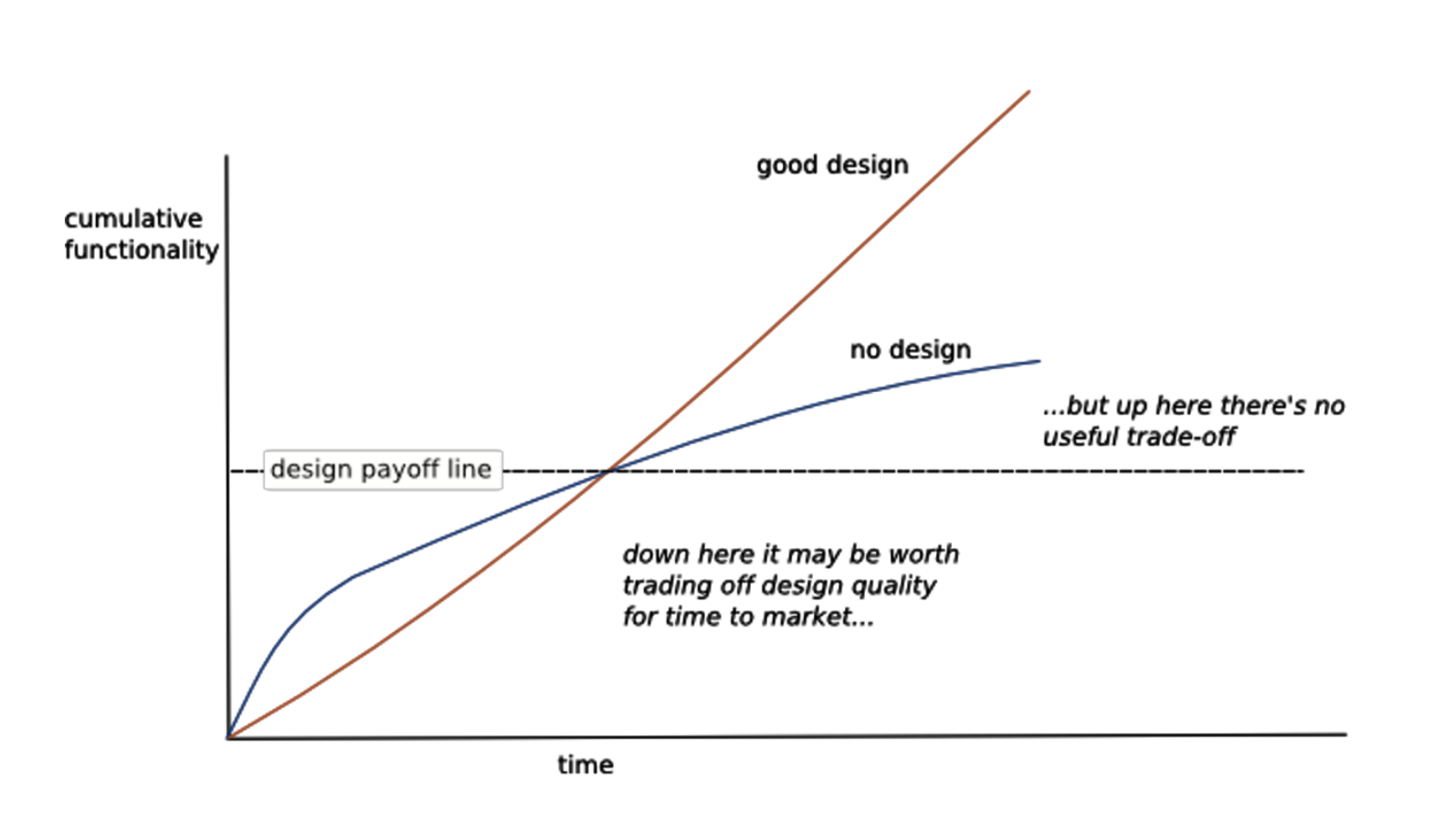
With AI, that point comes much sooner. Almost from the start.
This website has its own blog system. Building one today is easy; AI handles it. The interesting part is something else: hexagonal architecture, DDD, testing, dependency injection. Things that used to require discipline and extra time. I had an architecture file from another project. Passed it to the AI, asked for the blog system. One prompt. That's the cost. With good rules, it costs the same to do it right as to do it wrong.
And not just that. A predictable system is predictable for everyone: for developers and for the AI. In chaotic code, the AI has to guess where everything goes. In a clean architecture, the pattern is so clear that it becomes more precise. It gets it right more often. Simple as that.
It's no longer a long-term investment. It's the starting point.
//Taste, here too
Linus Torvalds has a famous talk where he shows, with code, two ways to solve the same problem. Both work, but only one shows good taste: it's more elegant, eliminates unnecessary complexity. It's not knowing more. It's seeing differently.
Since I started working with AI, this term has resonated with me a lot. We look to optimize workflows, standardize. We create rules, commands, work strategies. And that's the right thing to do, it's the foundation. But it's not everything.
That's where taste comes in. The "eye". Sensing where it's going to go before it goes. Knowing what not to say so you don't influence it. What to say even when it seems unnecessary. When to stop and when to keep iterating.
That's earned with the hours. There's no shortcut.
There's a phrase I see repeated a lot: "AI is a multiplier". Usually it refers to the ability to generate code, for better or worse. But there's another multiplier that gets less attention: the drive.
Lately I see problems I would have let go before and think: I can solve this. I want to solve it. An internal tool I always wanted to build. A spike to test an idea. This website. Things that weren't worth it because of the time they'd take. Now I see them as viable.
Delegating is letting go. Directing is keeping control without doing the work yourself. The temptation with AI is to delegate: it gives you something functional in seconds. But if you delegate the judgment, you end up with the generic.
The speed comes from the AI. What you want to build doesn't.